
Somnium
Marc Henry
OPENING:
Saturday 19 September 2026
7 — 11 PM
OPEN:
20 September
—
15 November 2026
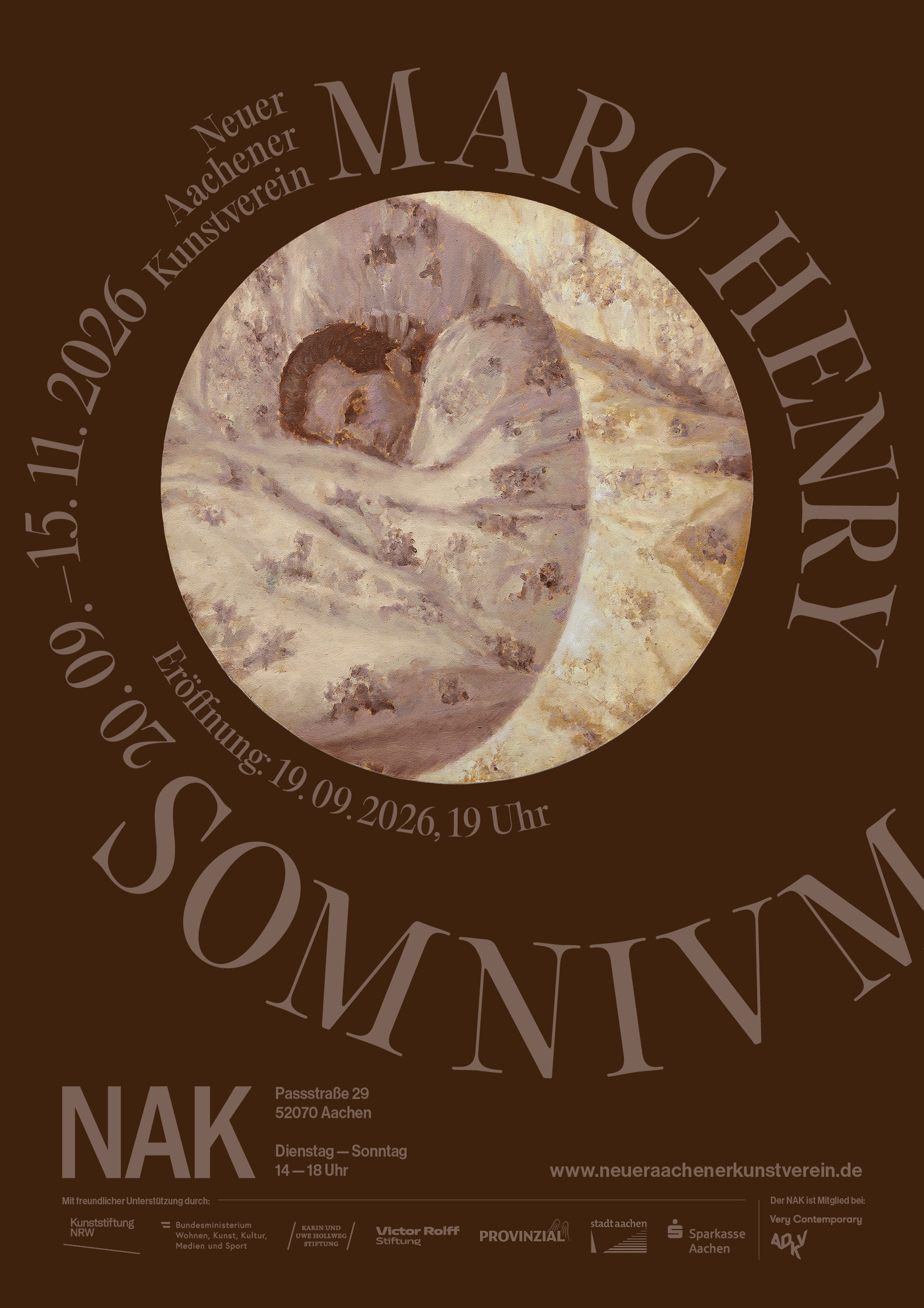
Vernissage: September 19, 2026, 7 pm
Duration: September 20 – November 15, 2026
Greeting: Prof. Ilka Helmig (Chairwoman, NAK)
Introduction: Maurice Funken (Director, NAK)
NAK Neuer Aachener Kunstverein is pleased to present Somnium, the first institutional solo exhibition by artist Marc Henry.
The exhibition’s title, Somnium (Latin for ‘dream’), is taken from the book of the same name by astronomer Johannes Kepler, written in 1609 and published posthumously in 1634. Somnium is considered one of the most influential and earliest works of scientific fiction, which continues to inspire scientific, literary, and visual motifs to this day: Kepler incorporated radical astronomical discoveries—particularly the Copernican worldview—into a fictional framework to make them conceivable, discussable, and socially acceptable. Fiction thus functions as an instrument of knowledge, but it can also become a target for misunderstanding, projection, and suspicion. This ambivalence became a biographical reality for Kepler when his mother, Katharina Kepler, was accused of witchcraft amid a climate of superstition and rumors.
In Somnium, Johannes Kepler describes a fictional lunar civilization in the form of a dream journey. With the help of spirits and demons, people travel to the Moon in the umbra of a solar eclipse. The text provides a genuinely scientific account of weightlessness and climatic conditions—particularly the extreme differences between day and night—a full 360 years before the first humans set foot on the Moon. It is precisely this intertwining of fantastical and real elements in the text that is symbolically reflected in the visual themes of Marc Henry, which are presented in the exhibition at the Kunstverein. The exhibition transposes this historical constellation into the present. In today’s media ecosystems, hybrid narrative forms are also emerging in which facts, speculation, emotion, and image production are inextricably intertwined. The image does not claim to be the truth, but rather reflects its own manipulative power.
Marc Henry’s artistic practice is characterized by an interest in narrative and composition, which is fueled by visual themes drawn from his personal archive of analog and digitally edited reference collages, his own photographs, and 3D rendering programs. In a dialogue between the digital and analog realms, the artist often returns to the digital file after his initial work on canvas. In this process, he alters the colors, adjusts the compositions, and integrates new discoveries from the painting back into the digital world. This rhythmic interplay continues until a pseudo-narrative emerges that is imbued with memories of reality but, in the terms of Jean Baudrillard’s concept of hyperreality, no longer reveals any references.
In the first exhibition room, there is a centrally located, atmospheric screening installation: two shiny metallic mechanical prism rotators—of the kind commonly used in advertising—display, in endless loops, film works that were each generated from three painted frames. The individual paintings on canvas. titled And So The Infinite Process Is Set In Motion I and II, are mounted on the respective panels and allude to the 1922 Swedish silent film Häxan (Swedish for ‘Witches’) by Danish director Benjamin Christensen, which, in a blend of fiction and documentary, explores the theme of the witch hunts through fantastical, even expressionistic imagery.
Because the rotors spin asynchronously, a constantly shimmering soundscape emerges—a rhythmic clicking, whirring, and flapping that fills and structures the space. The sounds merge with the constantly shifting image sequences to create an almost hypnotic backdrop; the mechanically generated loop of images and sound transforms Henry’s interest in artificial theatricality, digital transience, and subtle unease into an immersive, physically tangible form. The spatial composition is complemented by a large-format painting.
On the upper floor, the space below is contrasted by a tranquil retreat. In the subdued light, pointed-arch paintings are set into the window niches, their form reminiscent of church and chapel windows; their frames and displays are crafted from nickel-plated stainless steel, and through the shimmering materiality in shades of gold and silver, they evoke the tech-futurism of space travel in the spirit of Stanley Kubrick’s 2001, always—including in their motifs — drawing on Kepler’s imagined journey to the moon, its reception in media history, and related theoretical visual symbolism and narratives. In contrast, five round tondi paintings on wood, resembling crescent moons or sky discs, correspond to this.
Furthermore, the visual motifs in both series deliberately engage with art-historical references, even if these do not always seem clearly identifiable: for example, in a painting on a round arch, Goya and Galluzzo serve as equally distant models for Henry’s depiction of a figure—well-read and cultured—vanishing toward the moon, spreading the wings of a cloak from the study, yet also deliberately evoking a theatrical stage performance rather than a genuine journey to the moon—a fantastical journey, a journey of the imagination? The circular painting Keplers Traum, by contrast, places Kepler himself in the picture; the author and scientist is deeply asleep, an approaching solar eclipse casts its shadow on the scholar’s bed—beware, the moon demons are approaching, and the narrative, as described in the Somnium, takes its course. In another tondo, Henry combines Kepler’s cosmological theory from the Mysterium Cosmographicum with the development of the Kepler telescope. And Kepler’s mother, too, is depicted in her own biography in Katharinas Anklage. In this way, Henry weaves a pictorial cosmos in his paintings that, while finding its origin in Somnium, branches out like a delta, meandering through motifs, positing hypotheses, and developing stories. By subtly integrating the paintings into the existing architecture, the exhibition creates a space for reflection on how we engage with speculative knowledge in an age saturated with media.
The room is further broken up by the two sculptures Nachtmahr I and II that extract individual figures from the paintings, translate them into three dimensions, and thereby thematically blur the boundary between fantasy and reality—a first for Henry, who is thus further expanding his artistic practice to include the medium of sculpture.
Toward the end of the exhibition, the catalog of the same name will also be published by Distanz Verlag. The book brings together reproductions of works and exhibition views, but skillfully relates them to Kepler’s Somnium through Tim Bisschop’s graphic design. Texts by various authors, such as Alicja Schindler, also provide an art-historical context for Henry’s work. The catalog will be presented at the Kunstverein during this year’s Art Cologne. In an artist talk, Marc Henry will then discuss the publication, the exhibition, and his work. In addition, a new edition by the artist will be released simultaneously as a Jahresgabe by NAK.
Marc Henry (born in Munich in 1996) earned a B.Sc. in Economics from Ludwig Maximilian University of Munich and an M.A. in Curating from the University of Applied Arts Vienna before completing his studies at the Academy of Fine Arts Vienna in Daniel Richter’s class. His works have been exhibited at venues including Galerie Kandlhofer in Vienna, Galerie Anton Janizewski in Berlin, the Kunstverein Rosa Luxemburgplatz in Berlin, the MMIII Kunstverein in Mönchengladbach, the Schloßmuseum Murnau, the Kunsthalle Oktogon in Hitzacker, the Palais Rasumofsky in Vienna, and Belvedere 21 in Vienna. Henry lives and works in Vienna.
Kindly supported by:

